
There is nothing quite as fabulously satisfying as taking a raw piece of rock and turning it into a cabochon suitable for jewelry. Or, frankly, suitable for just sitting on a shelf and looking pretty. Of course, that just might be me. I love rocks, as I’ve stated previously.
Cabochons have been used in jewelry for hundreds of years. They’ve also adorned sword hilts, crowns and drinking utensils.
I have no idea how many cabochons I have made. At a guess, it’s probably over a hundred. I’ve made them from rocks I found while walking the hills and dry creeks where we used to live in Arizona. I have cut and polished a few of the rocks I’ve found in our new home here in Wyoming. But a lot of the cabs I’ve made have been from what lapidaries call “rough” that I’ve purchased. Sometimes the rough has already been slabbed (a slice of a larger rock), or they are rocky in shape and I have had to slab them on our trim saw.
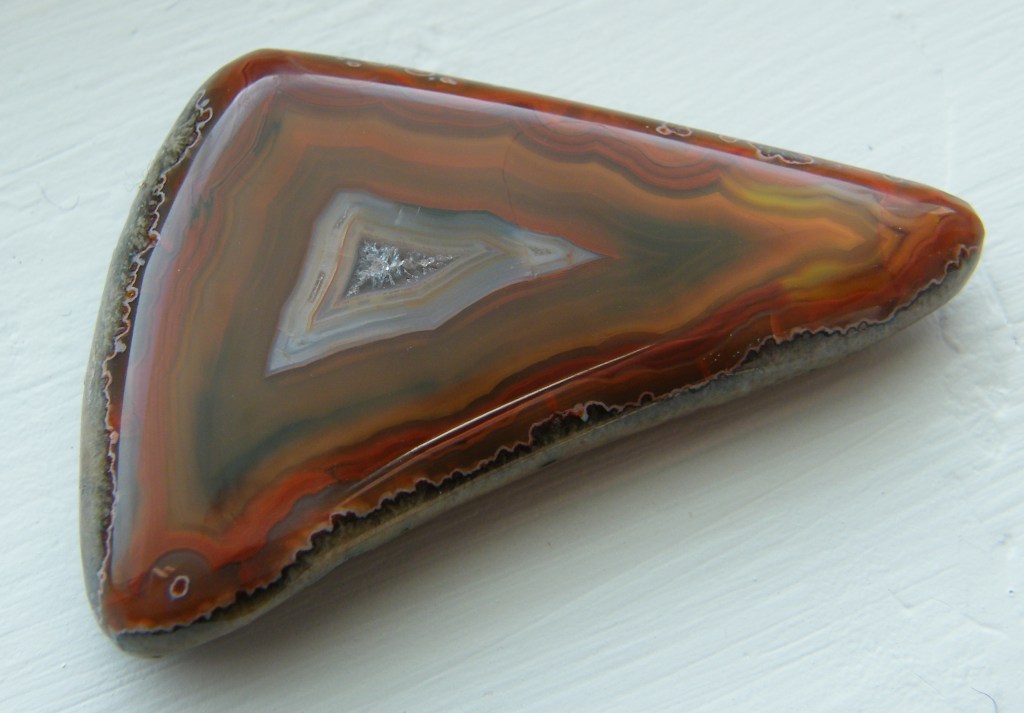
Laguna Agate from Mexico. 50mm x 33mm x 7.75mm
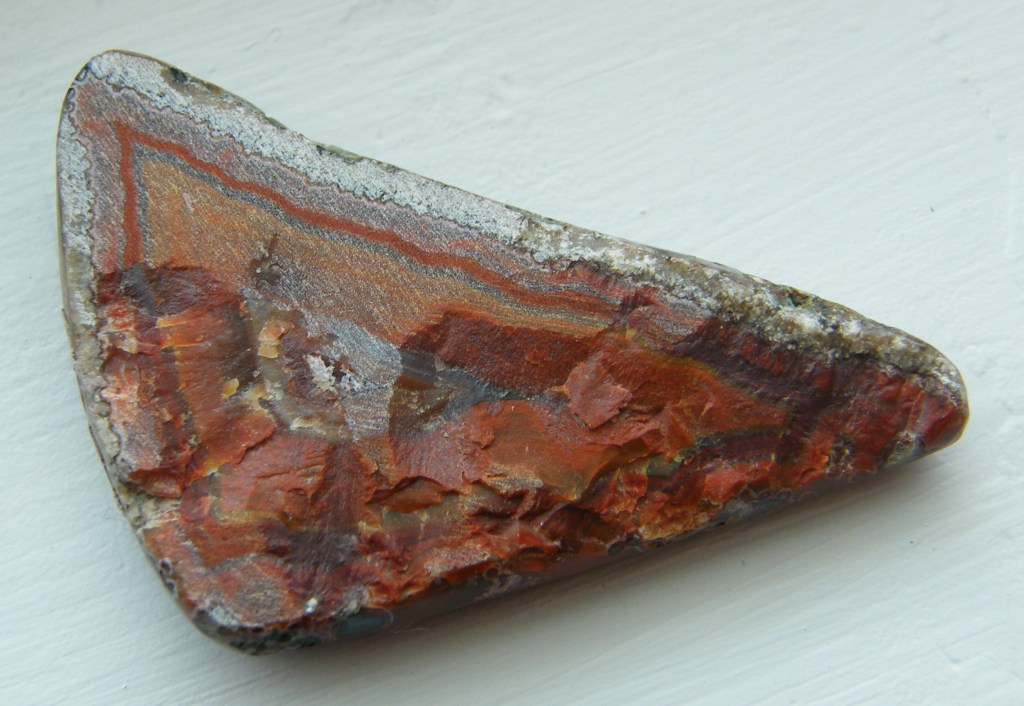
The same cabochon as above. I didn’t finish the back side because I plan to bezel set it. From this, you get an idea about how it started out and how the polishing brings out the colors and patterns.
Agates are probably my favorite. Petrified wood comes in a close second. Both of those are fairly hard and take a really nice high polish. But the truth is that I love all the different types of minerals. It’s just that some are easier to work with than others. Jade, for instance is fairly hard and you have to be sure to get all the deep scratches out with the coarsest grit wheel before moving on or you’ll be going back and forth until you reach a certain level of frustration and put it away for another day. Other minerals are so soft that you have to be careful not to take too much off in the beginning or you’ll end up with nothing. And some with a high copper content like malachite can be a bit toxic and you should wear gloves while cutting it.

Petrified wood from the Petrified Forest in AZ. 48mm x 30mm x 3.5mm
I once saw a piece of realgar at a gem show that was faceted and I was astounded because mostly you only see realgar as a display specimen due to the arsenic. I asked the vendor about it and he said he used both gloves and a respirator while cutting it.
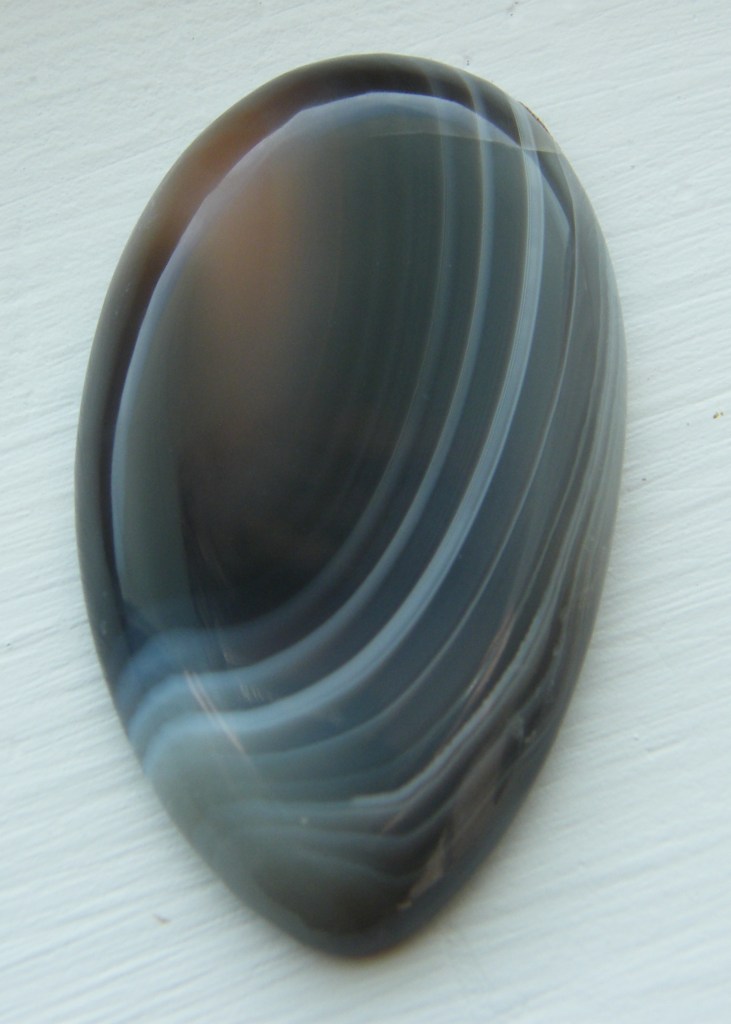
Botswana Agate. 42mm x 25mm x 5.5mm
When we lived in Arizona, I had a job at Arizona Gems and Minerals. The owner, George Koldoff, was a self-taught mineralogist and an awesome wealth of knowledge about jewelry making in general. He had a cabbing machine (Diamond Pacific Genie) set up in a back room and one day I asked if he would teach me how to make cabs because I was fairly desperate to add self-made pendants to my necklaces. He said he would teach me, but that he would get to pick the material for my first cabochon.
He took a piece of agate rough that had already been trimmed for a calibrated oval shape (they make stickers you can apply to help you in the final shaping) and showed me how to use a swooping motion with the wheels, how to move from grit to finer grit and finally do a polish with a hard felt mop and polishing compound with a polishing motor. I expected him to hand me a similar piece of not very good agate for my first cabochon, but he pulled a piece of very fine turquoise out of his pocket. It was the kind that had golden veining instead of black and was fairly rare. I told him no. He said yes, and told me to get started. George was not a man you argued with.
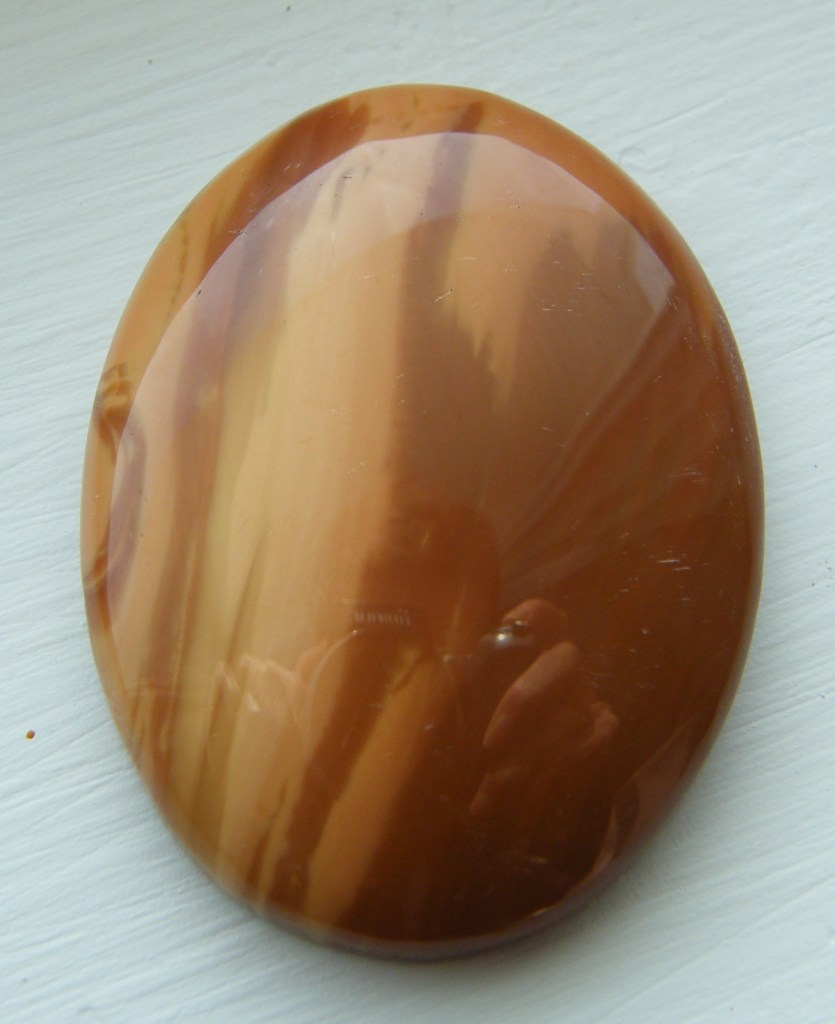
Imperial Jasper. I was once told that if you didn’t know what some mineral was, you would be fairly safe in calling it a jasper. 39mm x 30mm x 8mm
When I finished, I handed it to George for inspection. I hadn’t done a calibrated oval or round. I’d left it sort of freeform to save as much of the turquoise as possible. He took it from me and put it under a light and magnification. He pronounced it very good.
I told him I had weighed it and how many grams it was. I asked what that type of turquoise went for per gram and I labeled it for sale and was putting it into the front display case when he asked me what I was doing. I looked him a question and he said, “That’s yours. You always keep the first one.” I was astonished. It was a fairly expensive piece of turquoise.
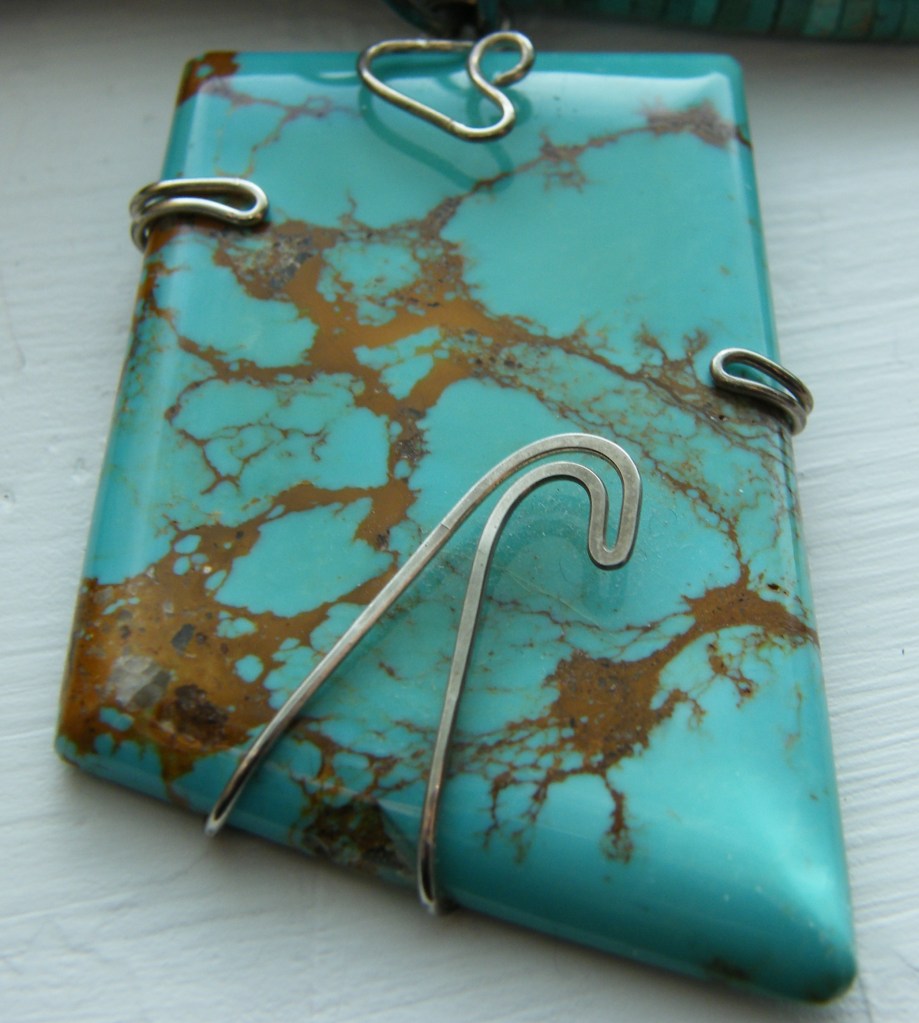
Golden vein turquoise. This is the first cabochon I made. I hadn’t yet learned to solder silver and so I wire wrapped a mounting.
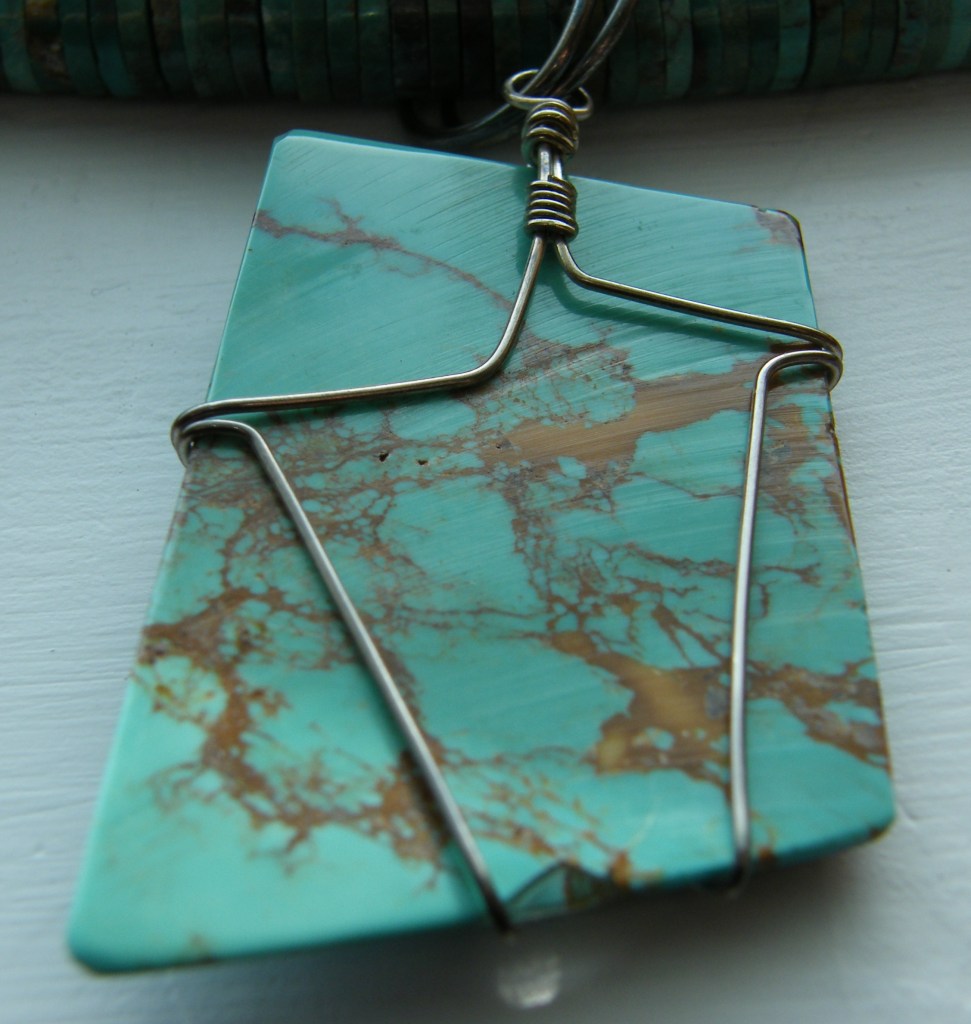
This is the same pendant as above from the back side. It’s not a lot of wire, but it is held very securely in place anyway. I try to design the wire-wrapped pendants so that a minimum of wire is used so as not to detract from the stone.
When it wasn’t busy, I’d go to the back room and make cabochons for the shop. I loved it so much, I wanted my own machine. But at the time, the Diamond Pacific Genies cost around $1,800. Then one day, a man brought his old DIY cabbing machine into the store to sell on consignment. It was a mess, but I wanted it anyway. There were buckets for the water uptake and effluent. There were sanding belts and a couple wheels. Each grit had its own water tap and water line. The motor was old and loud.

Biggs Picture Jasper. 30mm at the widest x 45mm x 5.5mm
I had Bernd come and look at it and asked him if he thought it was worth it and could he fix it up. He knew I really wanted it and probably wouldn’t have said no even if he thought that was the best course. So it went home with me. Sort of all in pieces.
George had given me a quick lesson in how it would need to be set up which I relayed to Bernd. It was several days before it was up and running.
It was a monster, but it was a dream come true. It threw water everywhere and we could only use it in the summer months because it was in the basement and in winter it was too cold to get all wet. But I made a lot of cabs on that machine. Bernd did too. When neither of us could stand the mess anymore, we shelled out the money for the Genie. We’ve never regretted it.
That first machine went back to the shop and was sold for a small profit over what I’d paid for it. A man bought it that, like me, was just getting started. Maybe that machine is still out there somewhere helping budding lapidaries get a leg up. I’d like to think so.
Please visit our Etsy shop to see more of our wonderful creations. Also, we’ve added a Clearance section with some great bargains in it. You can find it at jewelrybysyzygy.etsy.com


 Maddie's Mom Writes
Leave a comment